
January 26, 2026

2025 was a year of high geopolitical uncertainty and market volatility. Old rules are being rewritten, and we are on the cusp of a very different set of opportunities than those that have been ascendant over the past 15 years. Last year several of our core themes took flight, generating outstanding returns. We also began to rotate assets into new ideas and sectors that we believe will help us to continue to generate excellent returns in the coming year and beyond.
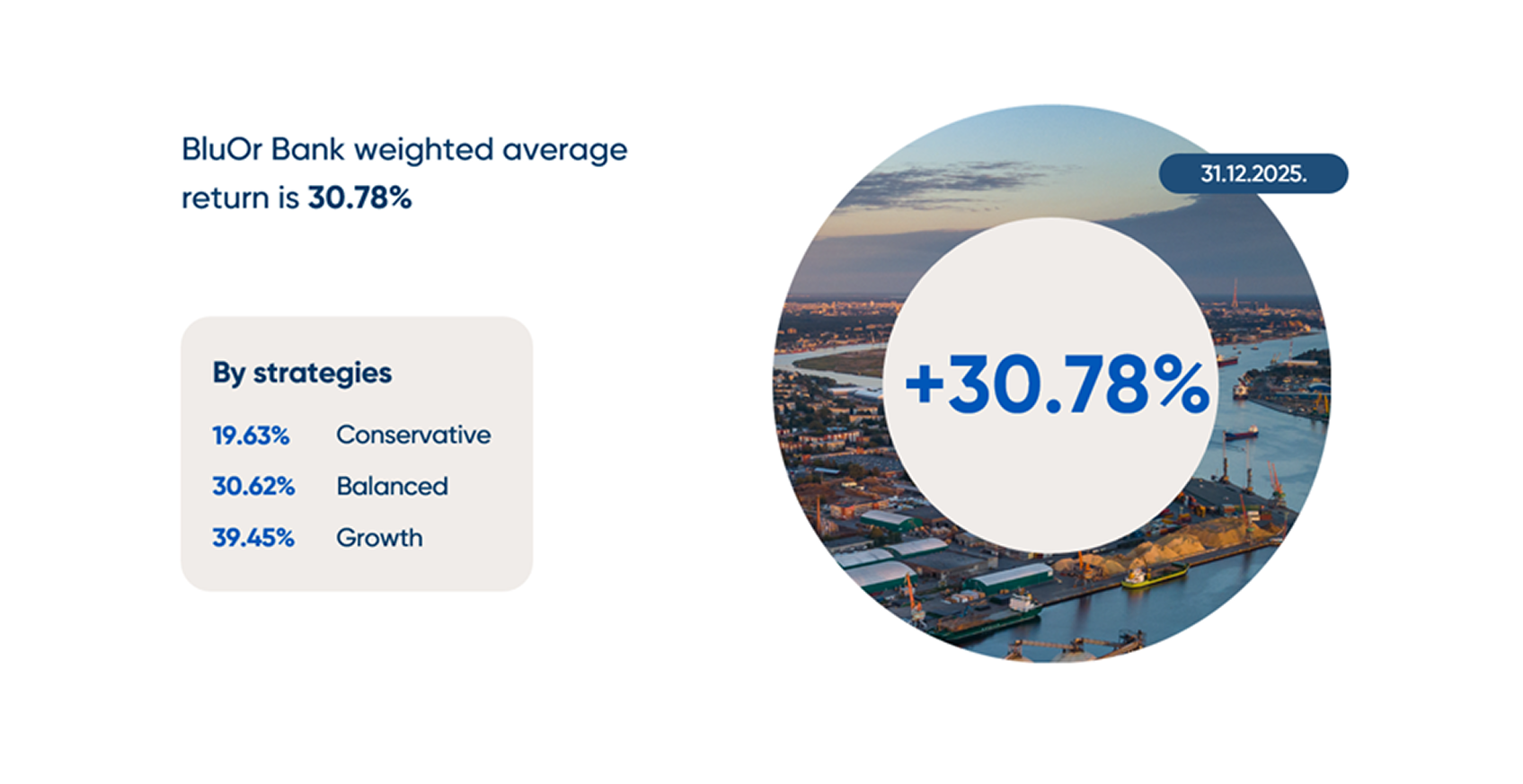
During 2025 we achieved an average weighted net return of 30.78% for our clients. Here is how our returns break down by strategy:
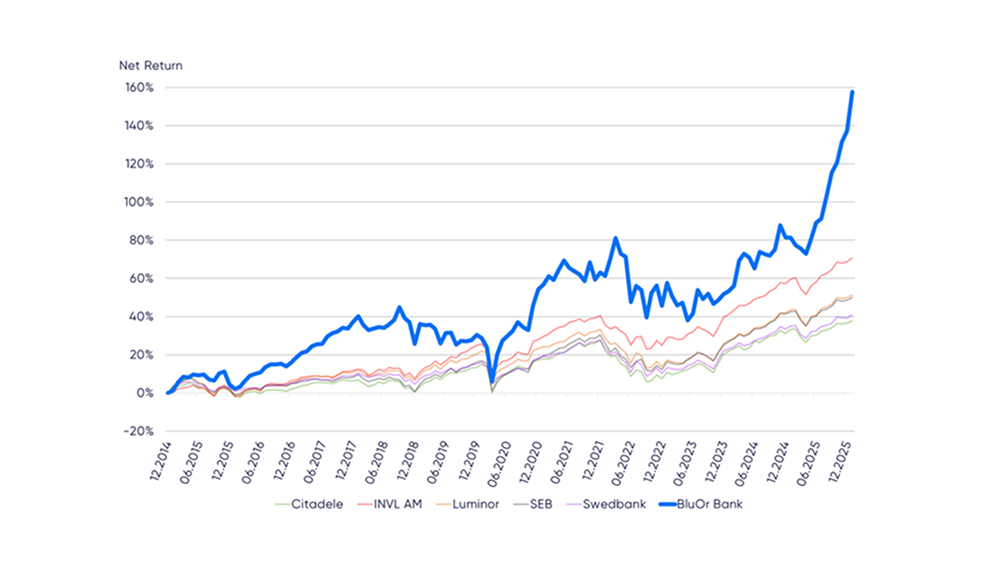
This is how our performance over the past 10 years compares to Latvian active pension funds:
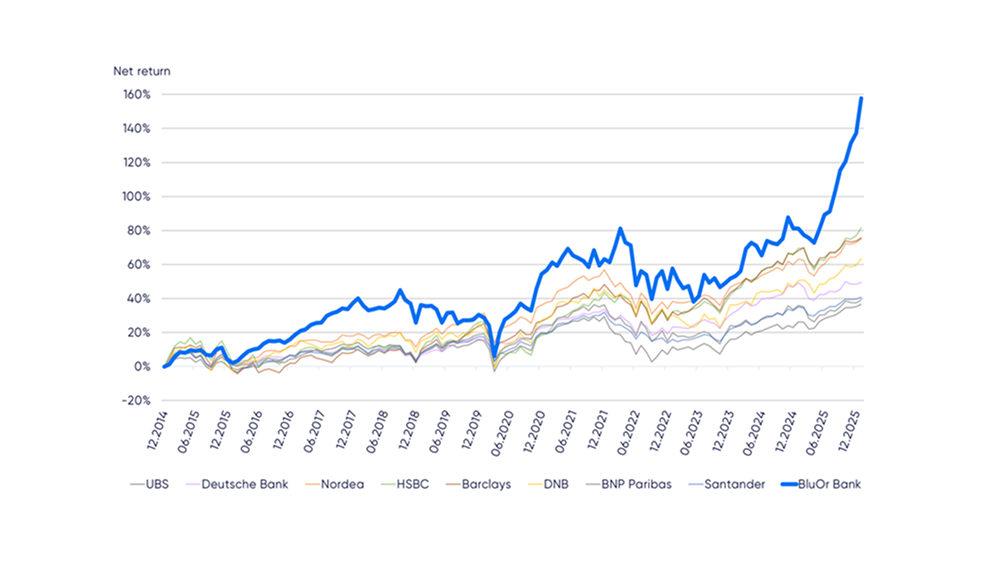
This is how our performance compares to balanced funds at European banks:
Here is how we performed against a benchmark portfolios comprised of ETFs:
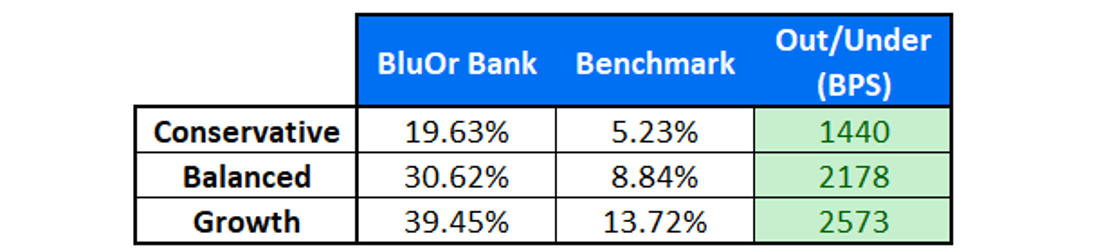
*Benchmarks: Conservative (MSCI World Equity 10%; HY Corp Bonds 20%; Global Bonds 70%), Balanced (MSCI World Equity 30%; HY Corp Bonds 30%; Global Bonds 40%), Growth (MSCI World Equity 70%; HY Corp Bonds 25%; Global Bonds 5%)
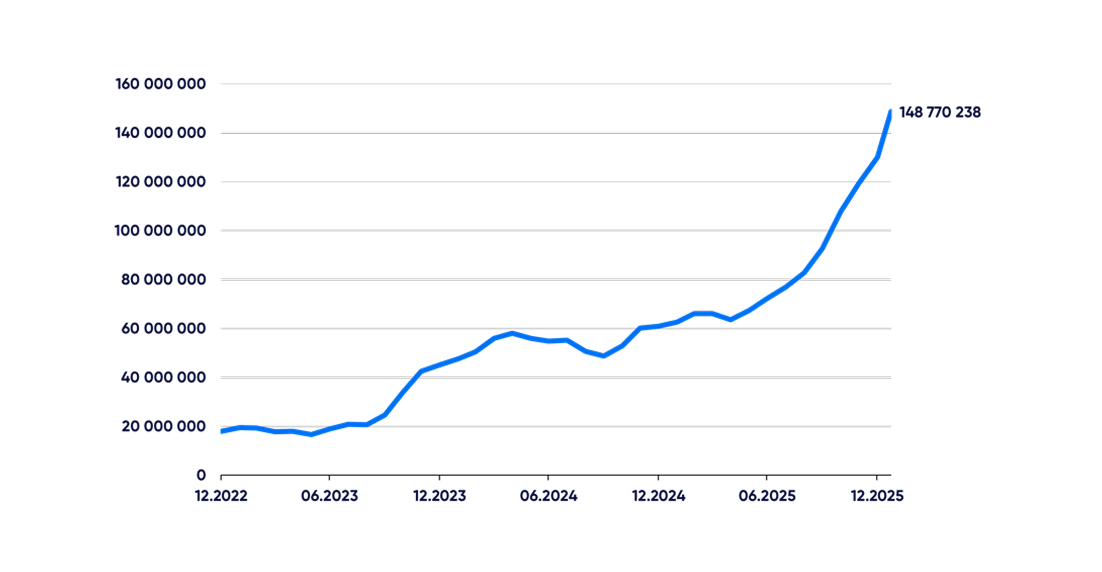
Over the past couple of years, our assets under management have grown significantly due to a combination of strong returns and net inflows of client funds.
Our performance differs significantly from other asset managers. There are several reasons for this, but following are the most impactful:
A critical view of where we want to be positioned or not be positioned based on our analysis of macroeconomic and geopolitical trends
Careful selection individual investments that give us the best risk adjusted probability of making money on any particular theme
Awareness of ‘big money’ positioning – where is money saturated and where it can flow to next
Position sizing - if we have strong convictions, we commit meaningful capital
Narrative GPS – awareness of what path we are on and how long we have to go before the full amplitude of our thesis is achieved. Also provides early warning signals if a thesis is straying from its intended path
Letting winners win – one of the biggest mistakes investors make is selling excellent investments too early, and not letting their returns compound. The best investments do not revert to the mean, they continue to distance themselves from it. We are committed to finding and holding these types of investments.
WHAT HAPPENED IN 2025
At the start of last year, we started to write a commentary that was titled “TRUMP 2.0 – ASCENT OR UNRAVELLING?”. This title turned out to be very appropriate for the year ahead. However, when Trump was inaugurated as President of the United States of America for the second time, his policy changes were so stark, manifold and overwhelming, that our attention veered immediately to protecting our client assets, rather than writing. We focused on identifying opportunities in the global market selloff that soon followed. Trump shifted narratives so quickly that we soon gave up trying to write our commentary . Instead, our attention was solely focused on managing our client portfolios. This was the right move. Had we waited, we would have missed incredible opportunities.
We expected that Trump would cause upheaval, and that his administration would differ significantly from the Biden era. Our key assumptions were: a persistent pressure on the Federal Reserve to lower interest rates, higher fiscal spending, less regulations, and geopolitical dealmaking.
Trump’s priorities soon crystalized in the following five major themes:
Lower the fiscal deficit through his DOGE (Department of Government Efficiency) initiative in partnership with Elon Musk
Lower the trade deficit
Tariffs as a source of government income
Lower illegal migration
Lower interest rates
As these priorities became clear we quickly analyzed their theoretical impact, as well as their likelihood of being actualized.
Let us go through them one by one.
Lower the fiscal deficit through his DOGE (Department of Government Efficiency)
This initiative had it all: Donald and Elon – a bromance for the ages, tech bros transforming government, a dramatic cutting of the deficit. However, this initiative intrinsically ran-up against a very powerful component of the US stock market’s exceptionalism: massive government spending, which has ostensibly transferred money from the public purse to the private sector in an unprecedented magnitude over the past 15 years:
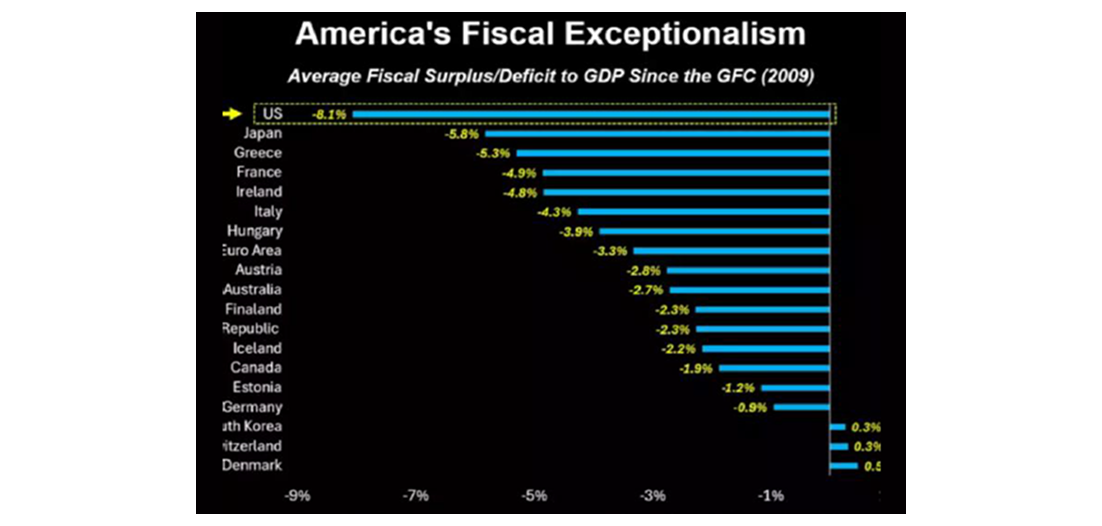
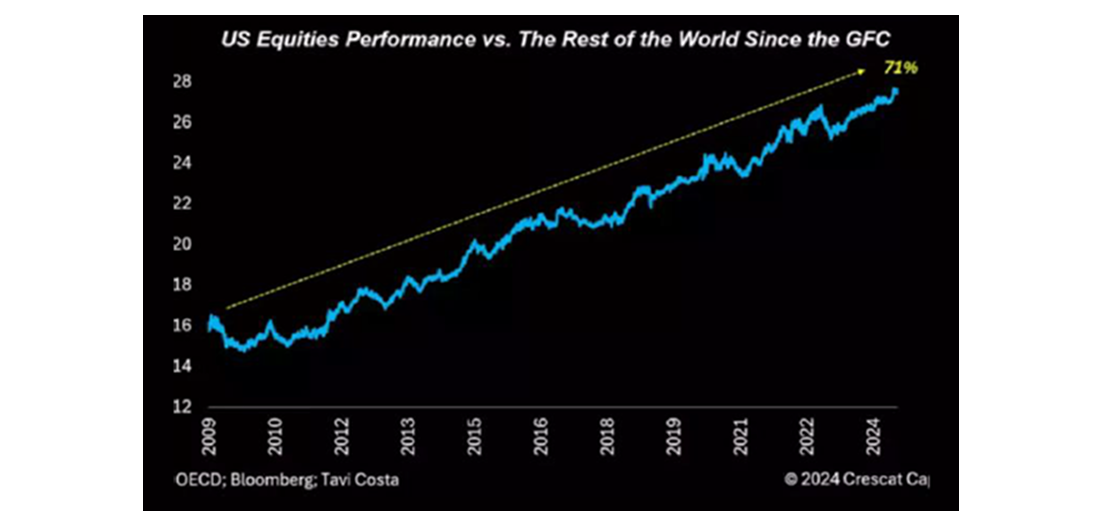
Had Trump cut fiscal spending, and interrupted this trend, the US stock market would have faced significant, sustained downwards pressure. Upon the announcement of DOGE, markets sold off, but as soon as market participants realized that DOGE was not to be, and that the US fiscal spending largess would not only resume, but be increased, US stocks rebounded strongly. We absolutely nailed this thesis by not going to cash during the sell-off. Instead, we positioned ourselves for the rebound in the assets classes that would benefit most from continued government spending, the consequent continued escalation of the US Federal Debt, and its potential undermining of the US as a monetary superpower – most notably, gold related assets.
Lowering the US trade deficit
Trump’s plan to lower the US trade deficit was based on 1) implementing tariffs on foreign imports, 2) encouraging more goods to be made in the USA. The tariffs he announced on ‘Liberation Day’ were preposterous through any interpretation of trade theory, and his subsequent adjustments, have made it difficult to plan increased US manufacturing capacity due to a lack of forward policy clarity that is a requisite for any significant investments in production. Upon announcement of his trade tariffs, the US trade deficit actually increased sharply as US importers tried to stockpile goods before the tariffs were implemented.
Tariffs as a source of government income
Yes, tariffs have thus far raised money for the government, albeit as a consumption tax on US consumers. Despite Trump’s rhetoric, there is no facility within his tariffs that ‘are paid by foreigners’. US consumers will begin to feel the impact of tariffs in earnest this year due to the inherent delay in product delivery cycles.
Lower illegal migration
This lowers the labour supply and puts upwards pressure on wages. The tactics deployed by ICE have elicited significant negative pushback at the polls:
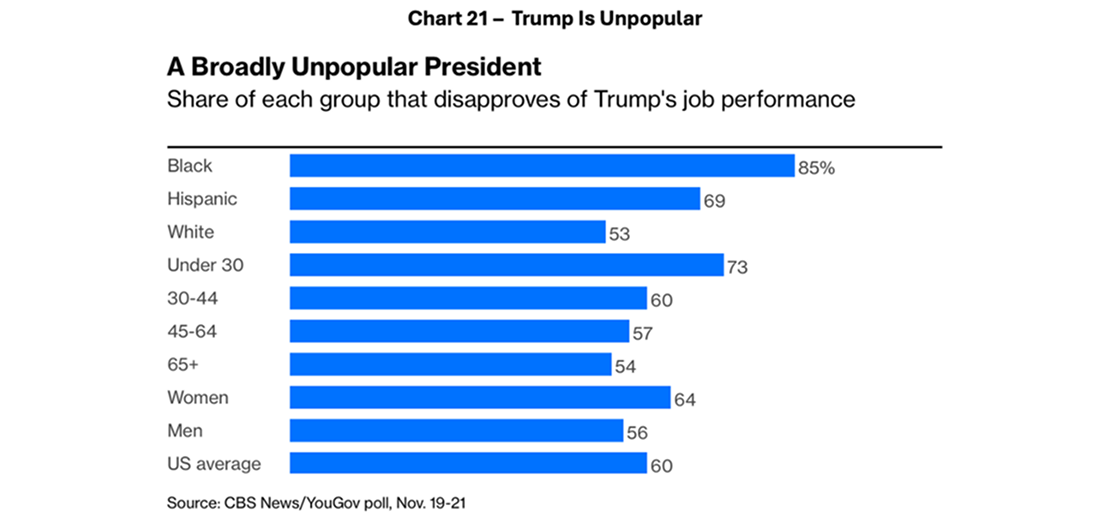
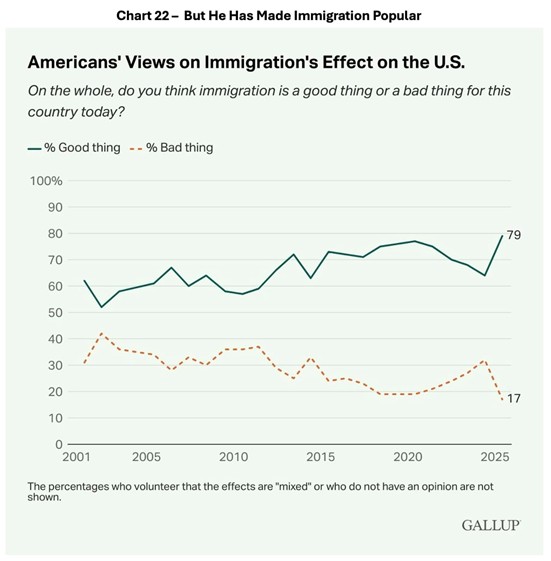
Also, there is no lack of irony in the fact that Americans now have a more positive view on immigration that ever before:
Lower interest rates
The Federal Reserve has cut overnight rates in 2025. Jerome Powell will step down in May of 2026 and there is a high likelihood that the next Fed Chair will be tasked with ensuring that rates continue to be cut. This will increase the risk of US government long bonds becoming untethered and steepening significantly in anticipation of higher inflation due to overly loose monetary policy. It is important to note that it is actually the 10 year yield that is more significant than the overnight rate due to the fact that it tends to be the reference rate for financing longer term CAPEX projects and mortgages, both of which are crucial to US productivity growth and economic prosperity. If the Federal Reserve were to step in to cap long rates, they would significantly undermine the US dollar.
Trump played a massive role in moving markets in 2025, and there is little doubt that he will have a conspicuous impact on markets in 2026 as well. However, Trump is by no means the only player, and whereas there has been a visible lack of will and courage to speak truth to Trump’s power by global leaders, capital market price movements speak volumes – and that is what we are tasked to pay attention to.
Let us take a look at what transpired.
INFLATION AND INTEREST RATE POLICY
During 2025, major central banks began to lower interest rates on the back of declining official inflation indicators.
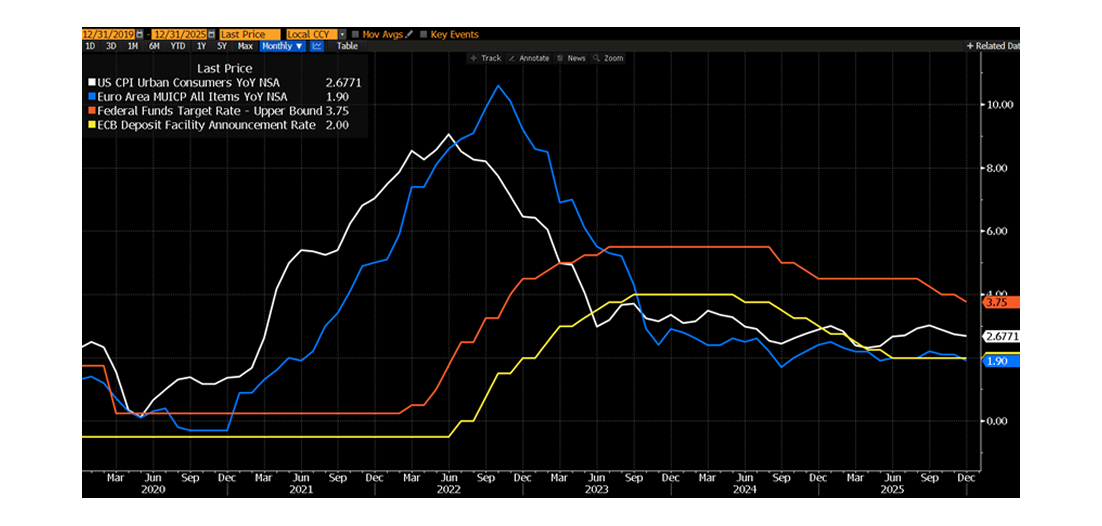
This past week in Davos, Trump reiterated that he believes that the US should have the lowest interest rates in the world. We think that this belief will continue to manifest itself in intent and there will be continued pressure on lower overnight rates in the US. Under such a scenario it would be difficult to imagine that other central banks would be able to raise rates in a timely manner if inflation were to begin to rise. This sets the table for considerable upside risk for inflation, and huge duration risk for long bond holders.
Our fixed income exposure in 2025 was based on our view that there would be positive global economic growth, but that political pressure on lower front end rates could elicit risk on the long end of the curve. As such, our chosen bond funds all have a lower duration bias, relatively lower credit quality, high yields to maturity, and have domiciles in countries where there is still considerable room for rate cuts. This means that we not only collect higher coupon income, but we also have the potential for capital appreciation through lower rates.
Here is how our bond funds performed in 2025:
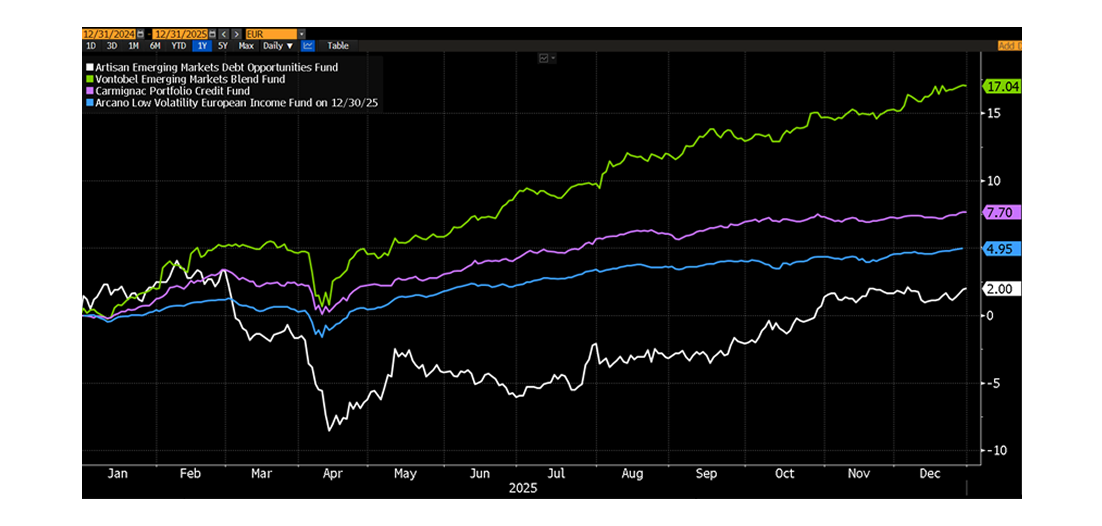
We continue to abide by this thesis in 2026, but will be vigilant in changing our positioning should that be required. Many investors consider bonds to be ‘safe’ investments. This is not objectively true. You have to focus on real returns. There is nothing ‘safe’ about investing in a bond or deposit that yields 2% in nominal terms (the average deposit rate in Latvia during 2025), when inflation is at 4% (the inflation rate in Latvia last year). Repeat this strategy and you will lose your purchasing power in 36 years.
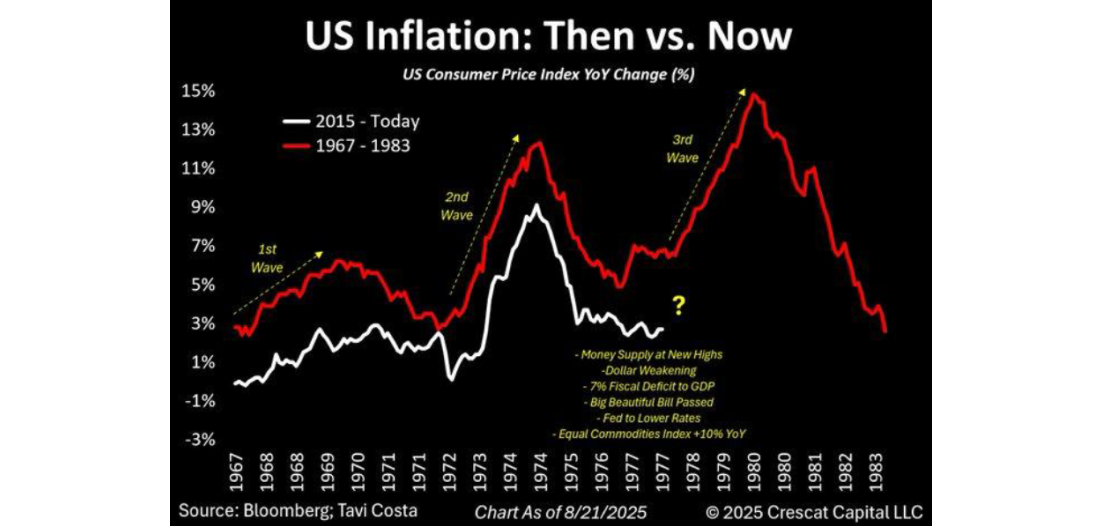
You want to be very careful with your bond positioning if a third, more powerful wave of inflation begins to form:
THE IMPORTANCE OF KNOWING WHERE YOU ARE
Markets are cyclical and adaptive. There are no eternal rules. You have to focus on where you are in the cycle and what is your optimal positioning. This allows you to a) avoid obvious errors, b) capture opportunities.
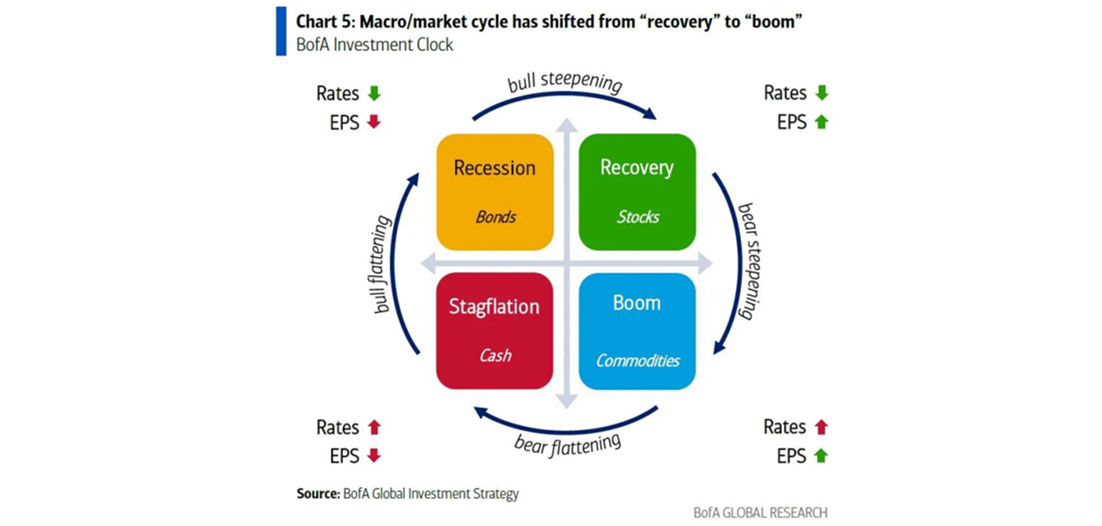
COVID had a significant impact on the typical progression of the market cycle, but a large amount of our success in 2025 was attributable to our analysis that we were entering the lower right-hand quadrant (blue: Boom and Commodities) of the market cycle. No two cycles are ever exactly the same, but they bear substantial similarities.
So what did we do? As previously discussed, we positioned our fixed income holdings to be protected from a ‘bear steepening’ (when long rates rise in anticipation of inflation). We also had considerable exposure to commodity producers – especially gold and copper producers. This served us incredibly well. Our Q1 2025 Model Growth Portfolio had the following allocations:
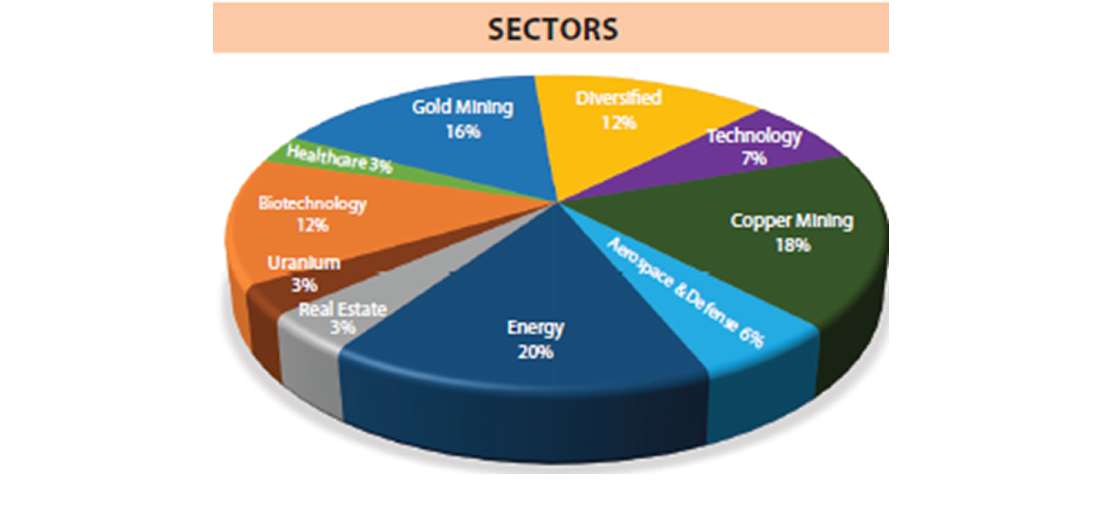
We had a combined gold and copper producer exposure of 34%.
If you were a passive investor that was indexed to the S&P 500, your exposure to these industries would have been the copper producer Freeport McMoRan (0.14%) and gold producer Newmont Mining (0.22%). As such, our exposure to these sectors was 100x that of the index, and this generated extraordinary returns for our clients.
I have been managing money for over 25 years, and have been through many cycles. I am distinctly aware that the next phase that will follow will require completely different positioning than we have now. However, I am also aware that cycles can last longer than you suppose, but can end very abruptly as well.
Despite the fact that our copper producer and gold producer equities returned more than +100% last year, a familiarity with cycles means that the current signal is not to sell, but to buy. You might say, ‘surely, it would be prudent to take profits after 100% gains’. My answer is ‘yes, it would be prudent. But it would not be wise.’ The current commodity cycle has the potential to be wildly powerful, even more so than the last cycle from 2001-2011.
During the last cycle, China led the boom. The Chinese were buying everything that you could dig or suck out of the ground to build their industrial economy. China remains the dominant buyer of all commodities and resources, but they are now facing competition from the Americans (data centers, power generation, infrastructure), Indians (their economy is at the stage of development that China’s was 25 years ago), Europeans (infrastructure, green energy, defense), and the Global South. All it takes for a bidding war is two buyers. The current set-up has five motivated buyers. What’s more, there are minimal global inventories, and supply is incapable of keeping up with demand for at least the better part of a decade. Traditional analytical thinking is incapable of quantifying the implications of these combined dynamics.
Here is a snapshot of some copper producers in the run-up to the Great Financial Crisis:
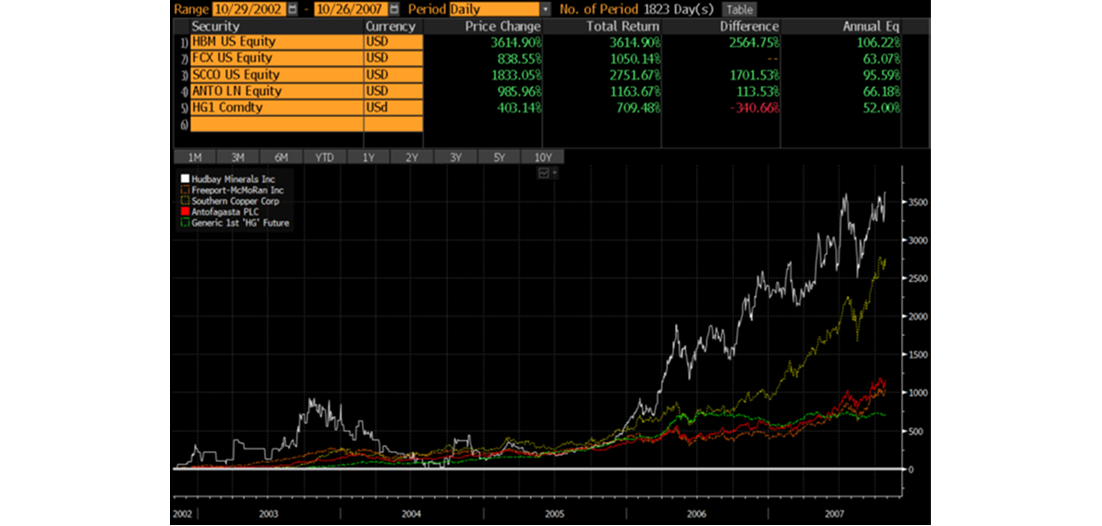
We have patiently been waiting for this thesis to kick into gear and will not be satisfied with 100%, 200%, 300% returns. This opportunity is far bigger than doubling your money, and we have a long road ahead.
THE IMPORTANCE OF POSITION SIZING AND LETTING WINNERS WIN
It is critically important to identify investments with high probability-adjusted returns. It is just as important to let them continue to grow and not be scared of your own success. Most managers have position size limits on their portfolios. This is a consequence of first level thinking. Here is the rationale:
Larger single positions can create more price volatility within a portfolio
They equate volatility with risk
Therefore larger positions create more risk
This seems to make sense.
Except, not really. Academic studies have shown that only a small number of companies are responsible for the overall performance of the stock market. As such, the true benefit of index investing is that winners never get sold, yet portfolio managers and individual investors typically feel the need to take profits and jump to the next ‘opportunity’.
By constantly cutting your winners, you ensure that you rarely allow your winners to compound and generate life changing returns.
For long term investors, volatility is only ‘risk’ if you fix your loss at an inopportune time. On the other hand, volatility can actually enhance your returns if you buy cheap assets when they are oversold.
At the start of 2025 our three largest equity holdings were Tenaz Energy (TNZ CN) at 6.37% of all of our assets under management, Source Energy Services (SHLE CN) at 6.10% of our total AUM, and HudBay Mining (HBM US) at 4.13% of our total AUM.
Our cost base for TNZ CN was CAD$4.65, and the price at the start of 2025 was $14.03, 202% above our cost base.
Our cost base for SHLE CN was CAD$6.30, and the price at the start of 2025 was $16.24, 158% above our cost base.
Our cost base for HBM US was $5.71, and the price at the start of 2025 was $8.10, 42% above our cost base.
How did our biggest positions perform?
TNZ CN closed 2025 at $26.50 (+89%)
SHLE CN closed 2025 at $15.19 (-6%)
HBM US closed 2025 at $19.85 (+145%).
Since the start of 2026, these stocks are +32%, +7%, and +26%. All remain large holdings.
OUR POSITIONING FOR 2026 – NO: US TECH, YES: EMERGING MARKETS, US HEALTHCARE, COMMODITIES, EUROPEAN EQUITIES
As I write this commentary on January 26th, our current average value weighted net return since the start of the year is +9.48%. Our key themes continue to perform, but we are by no means complacent.
We continue to believe that US equity markets are overpriced and overcrowded relative to the rest of the world. Moreover, there has been a significant change in narrative at the top of the US equity pantheon.
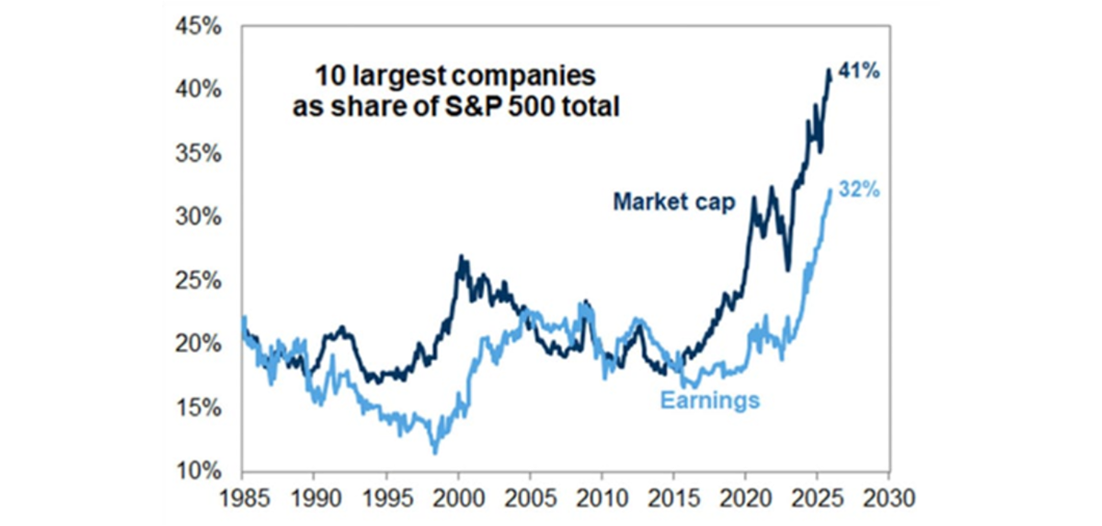
US technology stocks have been ascendant over the past 15 years. The primary reason is that they are excellent businesses, but there are some nuances which will be important going forwards.
The rise of big US tech has been based on high margins, low CAPEX, low rates, and buybacks. Their success was enhanced by the powerful rise of index investing.
As several of these companies transition to hyperscaling, they will invest massive amounts of money into datacenters, thereby increasing CAPEX. Until these AI related ventures start to generate profits, hyperscaling CAPEX expenditures will reduce earnings, margins and leave less cash for share buybacks:
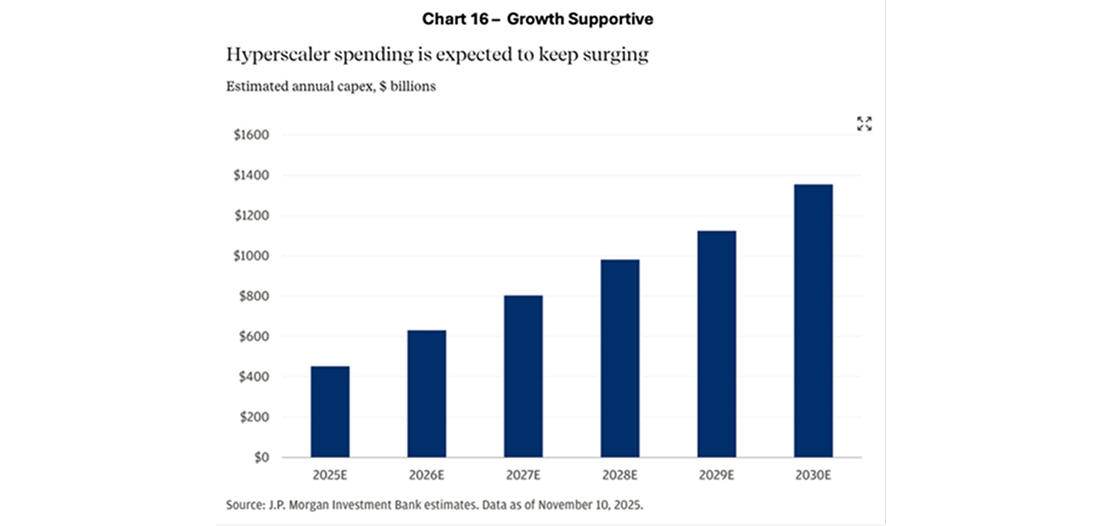
Basically, the factors that have powered their ascent, have now gone into reverse for the foreseeable future. What’s more, the US markets underperformed last year. If they continue to underperform, money will start to be moved elsewhere. If you are not winning, you don’t get money. It’s as simple as that.
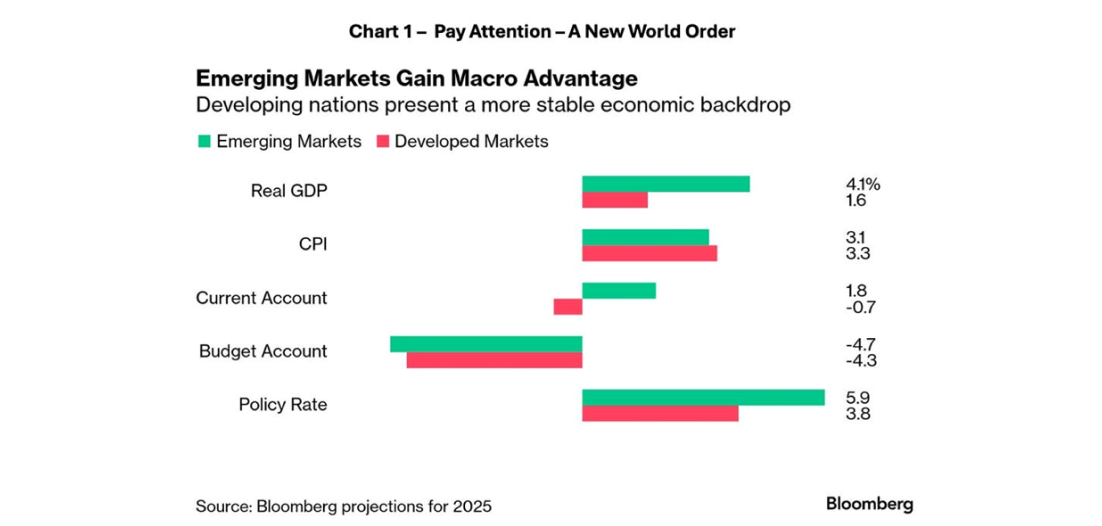
Consequently we have zero exposure to large US tech or the major US indices. We believe that Emerging Markets will continue their recent outperformance, and, as this continues, there will be more money that will either stay in their domestic markets or start to be allocated outside of the US. Currently, Emerging Markets have a very solid economic back drop and stand to benefit from a rate cutting cycle:
Given the size of the US market and the innovation that it has generated, you cannot write it off entirely. We believe that there will be a rotation within the US from tech to other sectors and that the primary beneficiary could be healthcare and biotech. Both are poised to benefit from AI without having to invest in the required CAPEX. Also, healthcare is a large S&P 500 component that could nicely absorb money flowing out of tech, while still seeking a profitable, innovative narrative.
There is a huge amount of European money in US financial assets:
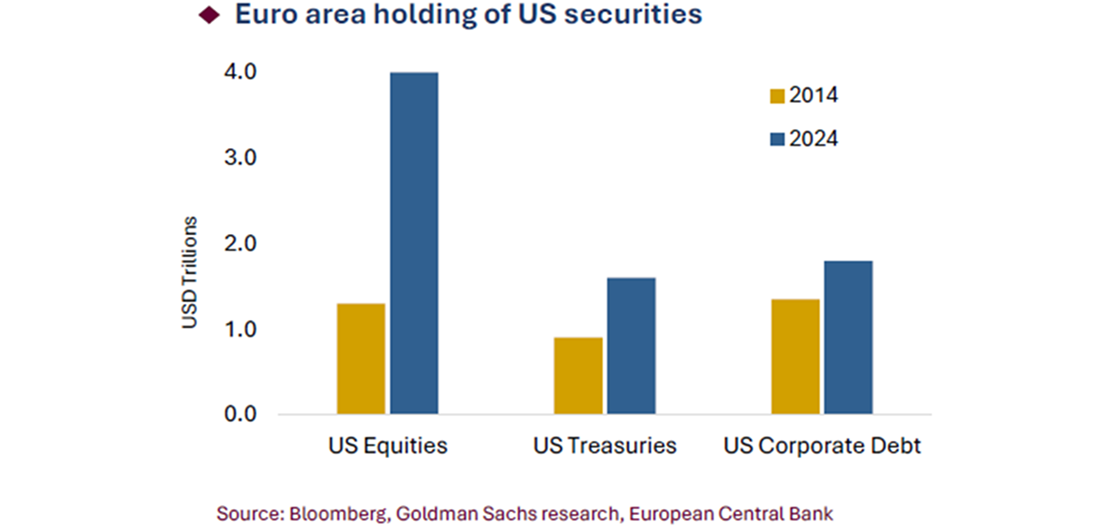
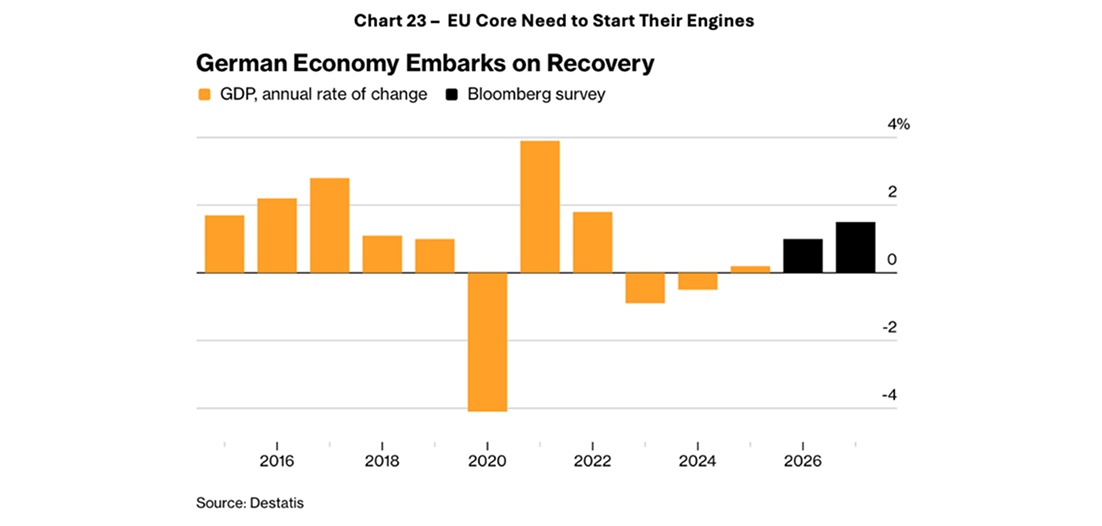
We believe that (1) due to the Trump’s contentious policies towards Europe, and (2) larger fiscal spending in Europe, more European money will stay in Europe and invest in European assets, or even begin to be repatriated. European equity markets had a brilliant year last year and they massively outperformed US markets on a euro equivalent basis. European managers have large exposures to assets in US dollars. This is why the average European bank’s balanced strategy made only +6% last year (reminder: we were +30%). Currently, big European managers have focused on hedging currency risk. If they begin to change their existing allocations away from US equities, things could get very interesting. We have been allocating to an excellent European equity fund manager who we believe is perfectly equipped to make money for us in European stocks over the coming years. Our core thesis is that German fiscal spending that will drive economic growth and continue to ignite animal spirits in European stock markets.
Returning to our commodity theme, we see signs of other metals joining the gold and copper rallies. Many of these metals markets are too volatile and illiquid to commit serious capital in individual, concentrated investments. Therefore our strategy has been to take a diversified allocation through our investment in a specialized precious and energy metals equities fund. This fund is still quite small (under 100mio euro in AUM), and is the flagship equity fund of one of the best mining investment managers in the world (over $9 billion in assets under management in private mine financings, commodity trading and now public equity investments). This allows us to benefit from the competence and market acumen of one of the best teams in the industry. It also enables us to get a sense of how their dialogue with large institutional investors is progressing.
Managers of very large pools of investment capital usually have internal criteria that they have to follow when selecting funds. I know this because I have developed close relationships with some of the largest fund selectors in Europe over the past 15 years. Two of the most basic, but important hurdles are (1) a three year track record, and (1) 100 million under management. As our chosen fund manager clears these hurdles, and if their core themes are still intact, they could see investor interest that is at least an order of magnitude higher than the money they currently manage. As early, significant investors, we will benefit from the fund buying more of the investments we already own in their fund over the length of the forthcoming cycle.
Although we have some stand out performances from individual energy companies, the sector has been relatively week due to low energy prices. We believe this is about to change.
Energy equities are already moving in advance of the commodities and positioning among institutional investors is low:
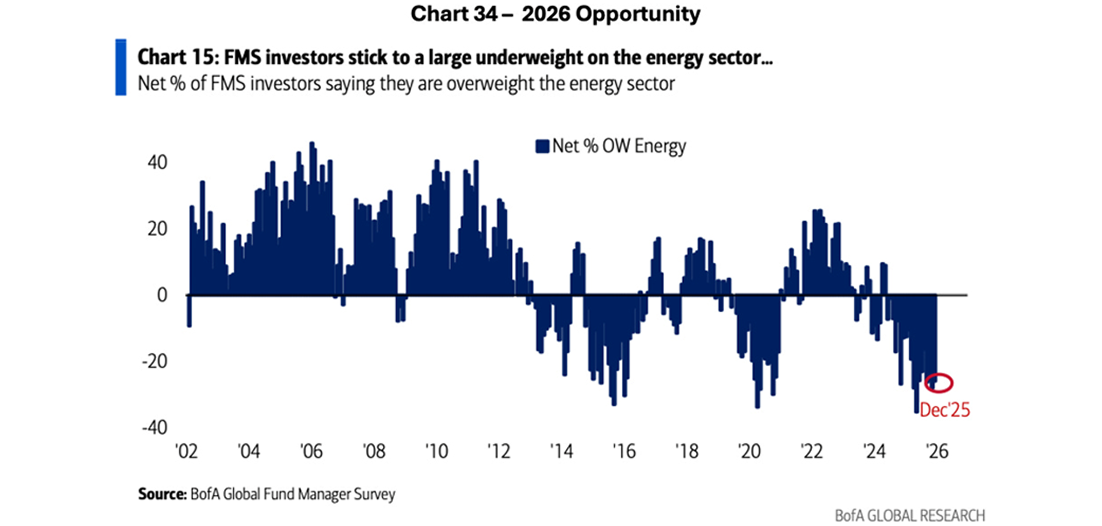
This is our favorite set-up: cheap valuations, low institutional investor ownership, and strong potential catalysts that will increase earnings. As new investors flock to get in on the action they also will also increase earnings multiples, resulting in tremendous returns.
Also, energy prices tend to move after gold and copper in commodity boom cycles:
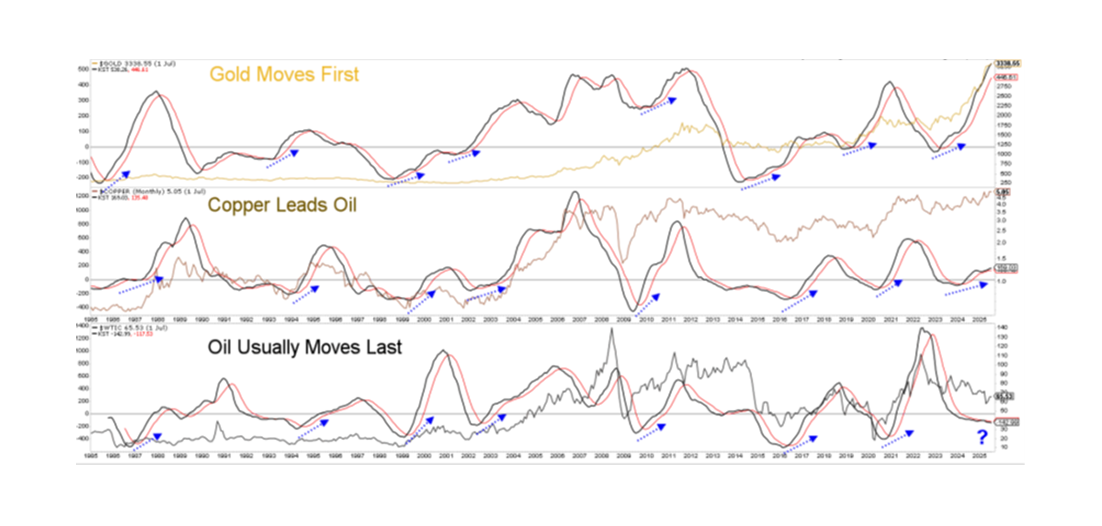
Got energy stocks? We do.
CONCLUSION
We have generated very strong returns for our clients by focusing of big themes and inflection points, and having the patience and conviction to reap the rewards. As discussed in this commentary, we still see incredible opportunity ahead.
As I write this commentary, we are closing in on 150 million euros in client assets. By our calculations, this makes us the largest private investment account portfolio managers in Latvia – bigger than two giant Swedish banks and two large US private equity-owned banks. This is a phenomenal achievement that has taken incredible vision, dedication and hard work. We are very grateful to BluOr Bank’s leadership for supporting our vision and letting us be different. We are also privileged to work with such an excellent, dedicated team of private bankers who truly care about helping their clients. And lastly, and most importantly, thank you to the almost 300 families that trust us to manage their assets. It is an honour and a privilege to have earned your trust.
Yours truly,
Pauls, Dmitrijs and Odrija
OUR TEAM

Pauls Miklasevics
Chief Investment Officer (CIO)
+371 6703 1412
pauls.miklasevics@bluorbank.lv
Pauls is the Chief Investment Officer at BluOr Bank. He is responsible for day-to-day decision-making and strategic planning for clients’ investment portfolios.
Pauls has 25 years of experience in investment management. He began his career as an institutional equity trader at a boutique mutual fund company in Toronto, Canada, and has spent the past 15 years managing investment portfolios for high-net-worth European clients in Riga, Latvia.
Pauls holds a BA in Economics from Queen’s University in Kingston, Ontario, Canada. He is a recognized investment expert whose views are regularly featured in local and international media, broadcasts, conferences, and podcasts. Pauls also serves as Chairman of the Board of Ronald McDonald House Charities Latvia.

Dmitrijs Brizgalovs
Portfolio Manager
+371 67 034 190
dmitrijs.brizgalovs@bluorbank.lv
Dmitrijs is a Client Investment Portfolio Manager at BluOr Bank. He is responsible for financial market analysis, the development and evaluation of investment ideas, as well as supporting strategic planning for clients’ investment portfolios.
Dmitrijs joined BluOr Bank in 2023. Prior to that, he worked at the Bank of Latvia as a quantitative investment and risk analyst.
He holds a BSc in International Economic Relations from the University of Latvia and was a recipient of a Baltic–American Freedom Foundation scholarship.
In addition to his professional background, Dmitrijs represented Latvia’s national basketball team as a point guard at the 2012 FIBA U18 European Championship.
IMPORTANT LEGAL INFORMATION
No Offer
Nothing contained herein constitutes an offer, solicitation or recommendation regarding any investment product or service, or an offer to sell or the solicitation of an offer to buy any financial instrument; nor shall any such services be provided, or financial instruments be offered or sold, in any jurisdiction in which such an offer, solicitation, provision or sale would be unlawful. All content is subject to applicable statutes and regulations. Any potential investor should satisfy oneself that an investment in any product and/or service mentioned in this material is permissible under the rules and regulations of their domicile. This material is not directed to any person in any jurisdiction where (by reason of that person’s nationality, residence or otherwise) the availability of the material is prohibited.
The information provided is for reference only and investors should determine for themselves whether a particular service or product is suitable and appropriate for their investment needs or should seek such professional advice for their particular situation. Please refer to offering documents for further information concerning specific products.
Certain statements contained herein may be statements of future expectations and other forward-looking statements that are based on current views and assumptions of BluOr Bank AS (hereinafter referred to as “BluOr Bank”) and involve known and unknown risks and uncertainties that could cause actual results, performance or events to differ materially from those expressed or implied in such statements. In addition to statements which are forward-looking by reason of context, the words “may, will, should, expects, plans, intends, anticipates, believes, estimates, predicts, potential, continue” and similar expressions identify forward-looking statements. BluOr Bank assumes no obligation to update any forward-looking information contained herein.
Investments
Past performance is no guarantee of future results. Investing in the financial markets is subject to certain risks including market, interest-rate, issuer, credit, and inflation risk. Financial instruments may appreciate or depreciate in price owing to conditions, whether real or apparent,
in a given market, economy or industry. The value of investments, and the income from them, can go down as well as up, and you may not recover the amount of your original investment. Where investments involve currency exposure, changes in rates of exchange may cause the
value of the investment to go up or down. Any tax benefits referred to on this material are subject to change and their availability and value will depend on your individual circumstance.
No Reliance
Although BluOr Bank has taken reasonable care to ensure that the information contained within this material is accurate, no representation or warranty (including liability towards third parties), expressed or implied, is made as to its accuracy, reliability or completeness by BluOr Bank.
Opinions and any other contents of the material are provided by BluOr Bank for personal use and for tentative reference only. Nothing contained on this material constitutes investment, legal, tax or other advice and is not to be relied upon in making an investment or other decision.
© 2026 BluOr Bank AS. All rights reserved.
Latest
-

With BluOr Bank’s support, a modern beach volleyball hall is being built in Ogre
Construction has begun in Ogre on a modern beach volleyball hall and sports center, developed with EUR 1.1 million financing from BluOr Bank.
-

BluOr Bank launches a new website and expands its range of services for private clients
Continuing its strategic development and expanding the range of services available to clients, BluOr Bank will introduce a new version of its website and an updated visual brand identity from Thursday, April 23.
-

BluOr Bank successfully completes 2025 and publishes the audited annual financial report
BluOr Bank delivers sustainable growth and strong performance
-

Apple Pay now available to BluOr Bank clients
From now on, BluOr Bank customers can use Apple Pay to make fast and secure contactless payments with their iPhone or Apple Watch.